
The close-knit hamlet of Wassaic, New York, has been a mill town, a railroad stop, a home to one of America's first condensed milk factories, and now a center for the arts.
It sits in a valley carved out by Wassaic Creek in Amenia, and it’s a place that, if you don’t know or pay attention to the signs on the side of Route 22, you might zoom right by.
Wassaic is also a place challenged by the now-common tension between longtime locals and newer residents that persists through rural communities across the Hudson Valley.
And especially in the past five years, likely accelerated by the pandemic, after a wave of new homeowners arrived from places south, Wassaic has experienced another significant cultural shift.

Ten Mile Table in Wassaic, New York
A bartender at the local VFW put it plainly when I visited: The words he hears from the old guard are that they don't feel welcome in their community anymore.
The Lantern Inn, a restaurant and bar that once served as the spot for lifetime regulars, has seen that crowd thin out. “When people moved up here for the pandemic, it was like Range Rover, Range Rover, Porsche, Range Rover, Cayenne,” Erika DaSilva told me. “[The former regulars] don't come.”
Erika owns Ten Mile Table next door to The Lantern. It’s a wine, spirits, and cider shop on Wassaic's main street that also stocks indie food magazines. She's a self-described “publication aficionado and nerd” who can tell you what's on page 16 of a 1998 issue of “W Magazine.”
She studied journalism at UConn and after college worked as a copy editor at Institutional Investor Magazine. (“It was bad. I can tell you a lot about the banking system in Kazakhstan, which helped no one.”)
She’s since published two very helpful volumes of “The Corner Table,” a community cookbook featuring recipes by the region’s chefs, farmers, cookbook authors, and other culinary people.
Now, she's channeling all of that energy into something new: a quarterly community newspaper called The “Hamlet Gazette.”
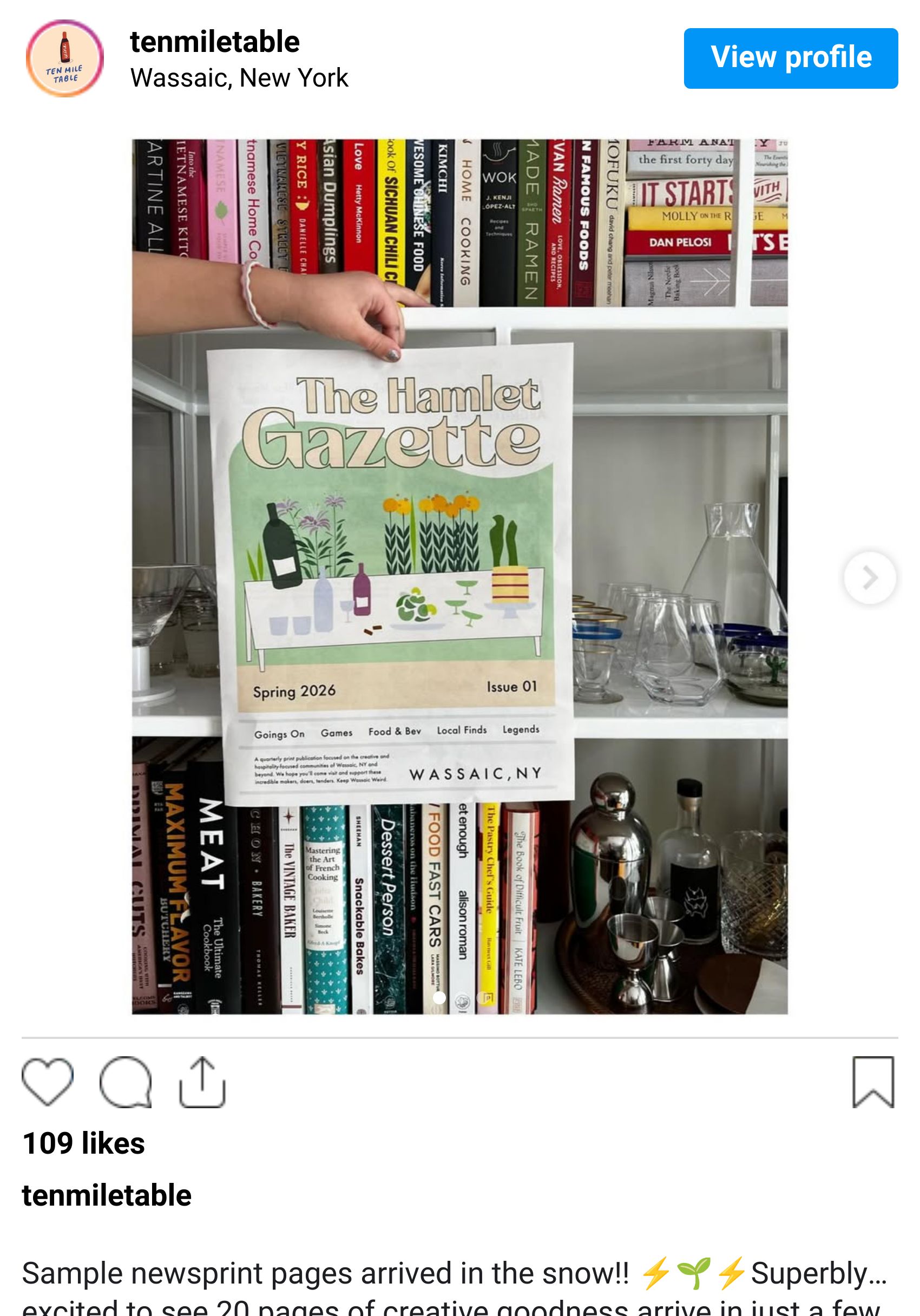
The first issue is 20 pages. It's got an events calendar, a section on local architecture and history, an advice column called “Ask Cass,” a dining review, a street style photo series, spring horoscopes written by a local community member with hyper-specific Wassaic and Amenia references, an “if you know, you know” crossword that sounds nearly impossible unless you live there, a feature on native plants and local CSAs, and, in every issue, a profile of a community figure everyone knows. The first legend: Sharon, a longtime fixture who only agreed to appear if she could write it herself.
“I think it's more important than ever to have things that are community oriented that are off of our phones,” Erika told me, picking up a proof copy and holding it up so she could peek at me over the top edge. “Physical, tactile. I would love it if I could see somebody out using and interacting with it.”
When I asked Erika if it felt like she was doing local journalism, she shrugged that off. She's not trying to compete with the “Millerton News” or the “Lakeville Journal.” The “Hamlet Gazette” is rather a quarterly record of a place, made by someone who shows up everyday, owns a shop that is almost physically at the center of Main Street, and sweeps the sidewalk every morning.
The mission evolved when Erika began putting together something for the holidays about local winemakers and nearby events. But, as she assembled the pieces, “it kind of became clear that it shouldn't be about the store, it should be about the street, and then all of the people that make the street great.”
Erika hopes the paper can help share stories back and forth across the divide between the generations, so that they learn about each other, and maybe remind people that the street still belongs to everyone.
The first issue of The “Hamlet Gazette” arrives in mid-April. It will be sold for $5 at Ten Mile Table (and maybe even at the newsstand outside, staffed by Erika’s daughter).
In this issue: It’s a Q&A with Olivia Muenter, whose new podcast, “Little Pod,” recently hit 10,000 downloads! We talk about our experience producing this show in under a few months, and all the ups and downs along the way.
⭐ ⭐ ⭐ VOTE FOR THE JIFFY ⭐ ⭐ ⭐
The Jiffy – the podcast version of the newsletter version of the James Cave Instagram Feed – is coming back for season 2 in April! I’ve got a full slate of episodes on the way — there’s one about trying to find out where upstate begins; an episode that looks at the migrant farmworker program across New York’s farms; a biography of the great and surprisingly funny painter Frederic Church; a Hawthorne Valley Cow You Should Know, and so much more.
And The Jiffy’s on the final ballot for “Best Local Podcast” in Hudson Valley Magazine’s “Best Of The Hudson Valley” awards!
Voting will help this podcast grow – and I could use your support! It only takes a few seconds, and you can vote right here: ⤵️

Catherine Newman (left), and Olivia Muenter in front of Catherine’s Pear Wall
The “Little Pod” that could
I first met Olivia Muenter when I worked at Kinderhook Books.
Based in nearby Stuyvesant, she would come in with her husband, Jake, and when her first novel, “Such a Bad Influence,” published, we hosted her as one of the stops on her tour.
We’d immediately become friends, and in the years since, have become really good friends! One evening, over ciders at Golden Harvest Farms, Olivia told us a story about her “ghost book.”
Her second novel, “Little One,” was going through edits, and she’d learned of another book coming out by debut author Rachel Taff with very similar elements (plot, themes, etc.).
Olivia is also a co-host of the “Bad on Paper” podcast, and so we started thinking, “Wow, it would be interesting to interview Rachel to see how you both are feeling about being each others’ ‘ghost book.’”
(As you’ll hear in the second episode of “Little Pod,” a “ghost book” is a concept that Chelsea Bieker uses to refer to a book that “comes out on the same day as yours, is in all the same roundups, is sort of just always right there.”)
That got us thinking – what if we created a limited series show about the publication of “Little One,” exploring all the feelings and questions Olivia experiences during the weeks when the book is locked but hasn’t come out, yet.
Anyway, we got to work, building the brand of the show, sketching out its structure; we knew there’d be voice notes mixed with narration. We were inspired by the podcasts of the industry’s early narrative era (“Millennial,” “Serial,” etc.), and we knew we wanted five or six episodes, each focused on an aspect of the publishing experience and industry.
The only things were: We had yet to schedule any of the interviews, we had very little time to do it, and for much of the production, Olivia would be out on tour.
Oh, and we added a road trip to the Outer Banks, because we wanted to end the series by interviewing one of Olivia’s childhood heroes: independent bookseller Gee Gee Rosell.
It’s been a week since we published the final episode, and I still can’t really believe that we pulled it off. It was extremely rewarding and educational, and I’ll always be thankful to have been given an opportunity to make something with a close friend. Truly a gift.
To celebrate the end of “Little Pod,” I thought it’d be fun to interview Olivia about her experience: why she wanted to do this, what she thinks now that we’re finished, and if she still wants to be my friend after having to put up with my edits.
Here’s our exit interview, edited and condensed for clarity:
This is where free ends.
The Jiffy is reader-funded. For $5/month you get the full story — plus maps, guides, and everything else below The Fold.
Upgrade & Support The Jiffy